Lufthansa and the Revolution of Premium In-Flight Dining Experiences
Explore how Lufthansa elevates business class service with the Future Onboard Experience program, transforming in-flight meals into high-end restaurant experiences.
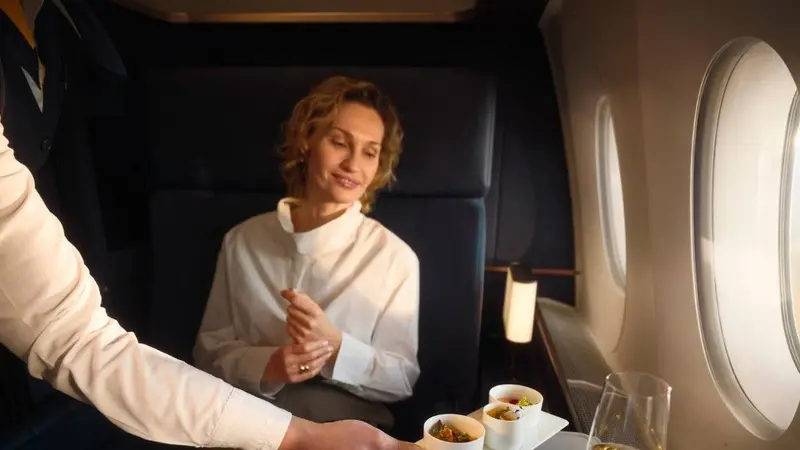
As hardware becomes increasingly standardized, service has become the primary battlefield for airlines. Lufthansa has recently put passenger experience on the line, accepting minor inconveniences to offer the sensation of dining in a high-end restaurant while in the air.

On the ground, a premium restaurant requires a spacious kitchen to prepare meals. On an aircraft, Lufthansa is finding ways to replicate this within just a few square meters. With the 'Future Onboard Experience' (FOX) program, the German airline is utilizing every inch of space on long-haul flights to perfect the meal service.
This decision reflects a quiet competition in premium aviation. As flat-bed seats and entertainment systems become standard, the dining experience has become a key differentiator. This aligns with the broader experience economy, where brands sell stories and feelings rather than just products. Airlines are now following this trend.

For decades, in-flight meals were often seen as the least appealing part of a journey due to mass-reheating processes. However, for business class passengers, these standards are no longer sufficient. With the FOX program, cabin crew don't just serve meals; they perform final assembly tasks on-board, such as garnishing and plating, elevating the service to something closer to a real restaurant.
The major challenge is technical design. Aircraft galleys are optimized for minimal space. On aircraft like the Boeing 787 Dreamliner, which has limited galley space, adding preparation tasks requires finding new areas. Lufthansa's innovative solution involves temporarily closing one of the two lavatories during the main meal service to provide support space for the cabin crew.
While closing a lavatory may cause minor inconvenience, Lufthansa is betting that the perceived value of a high-quality meal outweighs this short-term disruption. Passenger experience has become a core brand asset. As technical features like Wi-Fi or amenity kits reach parity across carriers, food remains the most effective tool for creating lasting impressions.
Partnering with Michelin-starred chefs or luxury food brands is not new for giants like Singapore Airlines, Air France, or Emirates. However, Lufthansa's FOX program goes further by integrating professional restaurant operational principles into the flight service. This requires delicate adjustments to recipes and seasonings, as human taste perception changes significantly at high altitudes.
Currently, the airline is testing this model on select routes to gauge passenger feedback and optimize operations. If successful, this marks a fundamental industry shift: the future of airline competition will not revolve around whose seat is wider, but whose experience is more memorable. Dedicating space for culinary excellence is a bold statement: fine dining is no longer an accessory; it is a fundamental part of premium aviation.